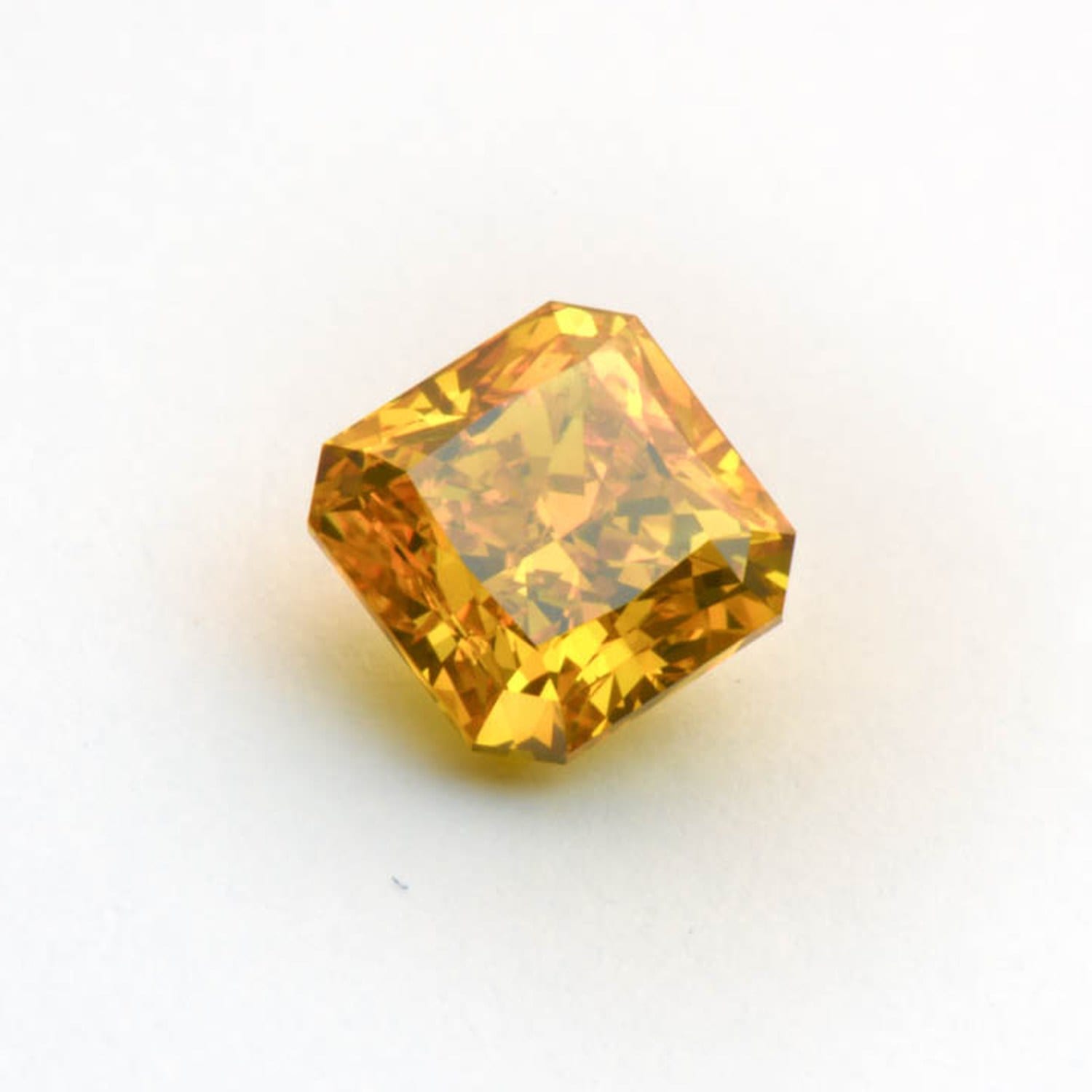
Fancy Colours
Fancy-Colour Diamonds: The Complete Guide
Past the foot of the white scale lies the rarest realm of all — diamonds graded not by the absence of colour but by its presence, where hue, tone and intensity decide everything.
The white scale measures a single thing: how little colour a diamond carries. It begins at D — the rarest, most perfectly colourless grade — and descends through degrees of faint warmth to Z. For the whole length of that scale the rule never changes: less colour is worth more. Then, at the foot of it, the rule breaks.
Push a hue past Z, deep enough that it reads as a true and deliberate colour rather than a tint, and the diamond leaves the D-to-Z world entirely. It is no longer a white stone faulted by colour; it is a fancy-coloured diamond, prized for the very thing the white scale was built to penalise. Here the logic inverts. Colour is no longer the flaw — colour is the whole point.
That inversion is what makes fancy colour the connoisseur’s quiet advantage. In the colourless world, value is largely a contest of size and clarity, and the largest budget tends to win. Among fancies a different arithmetic applies: a modest stone of the right hue at full saturation will out-rank — and long outlast in desirability — a far larger one whose colour is weak or muddied. Knowledge and a trained eye count for more than carats here. It is, for the patient collector, the most winnable specialty in the diamond world, and the arena in which a serious house earns its keep. The variety is extraordinary — yellow, orange, brown, pink, blue, green, and the almost mythical red — each arriving by its own route, with its own story written into the crystal.
Where the colour comes from
A diamond is, ideally, pure carbon and nothing else. Fancy colour is the trace of something that interrupted that purity: an element caught in the lattice as the crystal grew, or a distortion of the lattice itself. What caused the interruption sorts most coloured diamonds into one of three atomic Types — and those Types recur through everything that follows.
| Type | Cause of colour | Colours it gives |
|---|---|---|
| Type Ib | Nitrogen scattered singly through the lattice | Yellow, orange, brown |
| Type IIa | Distortion of the lattice; no measurable impurity | Pink, brown, red — and the rarest colourless |
| Type IIb | Boron in the lattice | Blue, grey |
Four forces, in the end, write the colour into a stone:
- Nitrogen, the commonest visitor to a growing diamond, lends warmth — the yellows, oranges and browns of Type Ib.
- Boron gives the cool blues of Type IIb, and uniquely leaves the stone able to conduct a charge.
- Natural irradiation, deep in the earth over millions of years, produces green.
- Lattice and plastic deformation — the crystal physically bent and sheared under pressure, with no foreign element involved at all — gives the pinks, browns and reds of Type IIa.
Because these mechanisms are so different, so is the rarity of what they make. Nitrogen is everywhere, so yellow is the most available of the fancies; boron and deformation are vanishingly rare, so blue, pink and red sit at the summit of the market. Understanding the cause is the first step to reading the stone — and to knowing whether the colour before you was made by the earth or by a laboratory.
Hue, tone and intensity — how a fancy is read
A fancy diamond is described by three qualities working together. Its hue is the colour itself — yellow, pink, blue and the modifiers that sit alongside them. Its tone is how light or dark that colour reads, from pale to nearly black. And its intensity is how deeply the colour saturates the stone — how much of it there is. Of the three, intensity is what the trade watches most closely, because it is the difference between a diamond that whispers its colour and one that announces it.
The grade runs along a ladder from the faintest trace to the most saturated expression a hue can reach:
| Grade | Saturation |
|---|---|
| Faint | Barely perceptible colour |
| Very Light | Slight, delicate colour |
| Light | Clearly present but gentle |
| Fancy Light | Soft, attractive colour |
| Fancy | Full, characteristic colour |
| Fancy Intense | Strong, saturated colour |
| Fancy Deep | Rich, with darker tone |
| Fancy Dark | Deep and shadowed |
| Fancy Vivid | The purest, most saturated of all |
The same hue can sit anywhere on this ladder. A Fancy Light yellow and a Fancy Vivid yellow are the same colour by name, yet worlds apart in presence, in rarity, and in price. This is where a buyer’s real leverage lies. With a colourless diamond, carat weight drives value sharply and predictably. With a fancy the order of importance shifts: a smaller stone of exceptional intensity will routinely outvalue a larger one of weaker colour, because the strongest saturations — Fancy Vivid above all — are the rarest to occur in nature, and it is rarity, not size, that sets the price. Chase intensity, not weight, and a sensible budget reaches far further than it would in the white.
Tone and hue temper the picture. A colour that reads too dark, or greyed and clouded, loses appeal even at high saturation, while a pure, clean hue at full intensity is the most coveted combination of all. The grader’s task is to weigh the three together and find the single description that captures the stone — never against the white comparison set, but on the fancy’s own terms.
With cause and measure established, the colours themselves — each with a distinct origin, a distinct scarcity, and a distinct character on the hand.
Yellow — the scale’s villain becomes its prize
On the white scale, yellow is the enemy: the faint warmth that pulls a stone down from D toward Z. Push that same warmth far enough, though, and it stops being a fault and becomes a colour in its own right. A fully saturated yellow diamond is the canary — the most recognisable of all the fancy colours, and the one that turned the scale’s villain into its prize.
The colour comes from nitrogen, the most common element to find its way into a growing crystal. Scattered through the lattice, it absorbs light at the blue end of the spectrum and leaves the warm glow we read as yellow. It is the very same impurity that tints a J or a K stone; only the concentration differs, which makes yellow a Type Ib trait — the warm branch of the diamond family. The old trade names trace the journey: a faintly tinted stone is a Crystal or a Cape; deeper, a Light Cape; deeper still, a Dark Cape. Somewhere along that line the colour crosses over. It is no longer a yellowish white but a true yellow, and the stone leaves the scale to be graded as a fancy. That crossing point is exactly where Cape yellow tips into Fancy Yellow.
Of the fancies, yellow is the most available — nitrogen is, after all, the commonest visitor to the lattice. But most available among the rarest stones on earth is still rare, and a clean, intense canary remains a genuinely scarce and coveted thing. Its warmth is also flattering to wear: a yellow diamond comes alive in a warm setting, where yellow gold answers the stone’s own colour rather than fighting it.
Orange — nitrogen’s fire
Orange is yellow’s rarer cousin, from the same source: nitrogen, concentrated so the warm glow deepens toward flame. It, too, is a Type Ib colour. But a pure orange, free of brown or yellow modifiers, is enormously scarcer than a yellow — one of the least common of the warm fancies, and among the most sought after when it appears clean. Most orange stones carry a qualifier — brownish, yellowish, brownish-orange — and the market prizes those that come closest to a true, unmodified fire orange, the great pumpkin-coloured stones that fixed the colour in the public imagination as one of pure heat. It wears with the same warmth as yellow, and rewards the same instinct: hunt for purity and intensity of hue rather than size.
Pink — colour without an element
Pink breaks the usual rule. Yellow comes from nitrogen, blue from boron — each a foreign element caught in the lattice. Pink comes from no element at all. It is thought to arise from lattice and plastic deformation: the crystal, squeezed and sheared deep in the earth, was physically distorted, and that distortion bends the way it absorbs light. The colour is written into the structure itself, not into an impurity.
Because no measurable impurity colours it, a pink diamond is overwhelmingly Type IIa — the same exceptionally pure, highly sought-after group that yields the finest colourless stones and sets records at auction. Pink sits among the rarest and most valuable fancies of all, and a clean, saturated pink of real intensity is one of the most coveted stones any house can hold. Red, its neighbour, is the same deformation taken to an extreme — the scarcest natural colour of all, counted in a handful of known stones.
For decades the world’s supply of pink rested largely on a single source: the Argyle mine in the remote north-west of Australia, which produced the great majority of natural pinks. Argyle has now closed. With its richest source exhausted, supply has tightened sharply, and stones that were already rare have become rarer still — a scarcity the market has felt keenly, and one that has only sharpened the case for buying carefully and with proof of origin.
Blue — boron’s semi-conductor
Blue is the cool exception in a family that runs mostly warm. Its colour comes from boron, an element that enters the lattice in place of carbon and absorbs light at the red end of the spectrum, leaving the deep blue we see. Boron makes a blue diamond Type IIb — and gives it a property no other diamond shares.
The boron that colours a blue stone also leaves it semi-conductive: it carries a faint electrical charge, where every other diamond is a perfect insulator. This is more than a curiosity — it is a signature of natural origin. Irradiation and other treatments can mimic a blue hue, but they cannot reproduce the semi-conductivity that boron confers. The stone’s own physics testifies to how it was made, and gives the laboratory a test that appearance alone can never pass. Natural blues range from a pure, saturated blue toward stones carrying greenish or greyish hints; as with every fancy, it is intensity that governs value, and a deep, clean blue of strong saturation is among the most coveted colours a diamond can take.
No blue is more storied than the Hope Diamond — the deep blue stone whose history and mystique have made it the most famous coloured diamond in the world. Stones of that order are extraordinarily rare; natural blue is one of the scarcest fancy colours to occur at all.
Green — the earth’s own radiation
Green is the rarest of the natural fancy colours but one — only red is scarcer — and its origin is unlike any other. The colour is not an element in the lattice but a scar of natural radiation: over millions of years, radioactive minerals in the surrounding rock bombarded the crystal, displacing carbon atoms and altering the way the diamond absorbs light. The earth itself, slowly, turned the stone green.
Because that radiation acted from outside, its effect is often shallow — concentrated in a thin skin at the crystal’s surface rather than running through the whole stone. This makes green the cutter’s heartbreak: the very act of shaping and polishing the rough can grind away the radiation-stained skin and take the colour with it. A green that survives, evenly, into a finished stone is a genuinely rare event. The great exemplar is the Dresden Green — a large, naturally green diamond of exceptional, even colour, and the stone against which all natural greens are measured.
Green is also the hardest fancy to authenticate. The same radiation that colours a stone in nature can be reproduced in a laboratory, and a treated green can look much like a natural one — the distinction can turn on subtle evidence that only a laboratory can read. Here more than anywhere, the certificate is not advisory but indispensable.
Brown — champagne and cognac
Brown is the fancy colour the trade learned to love. Long dismissed as the plainest tint a diamond could carry, it was reframed — brilliantly — as champagne and cognac, names that turned a warm brown stone from an afterthought into a thing of character. The colour runs from pale, golden champagne through to deep, glowing cognac.
Like pink, brown owes its colour not to an impurity but to lattice and plastic deformation — the crystal physically distorted under the pressures of its formation, bending the way it absorbs light. It is the same mechanism that produces pink, expressed as warmth rather than rose, which is why the finest browns sit close to the pure Type IIa family. What sets brown apart is abundance: it is the most common of the fancy colours, and with that comes its great virtue. It is the most affordable way into a genuinely coloured diamond. Where pink and blue command the heights of the market, a champagne or cognac stone offers true fancy colour at a fraction of the cost — fancy colour one can actually wear every day.
Much of that modern appeal was the work of the Argyle mine, which produced browns in abundance and gave them their evocative champagne-and-cognac language. The marketing did more than sell stones; it taught the eye to read brown as warm, characterful and inviting rather than dull. For a buyer taking a first step into fancy colour, brown is the natural place to begin.
Type IIa — the purest 1.8 percent
Return, at the last, to the purest branch of the family — because it underlies so much of what makes fancies rare. A natural Type IIa diamond is worth a great deal more than a comparable Type Ia stone, and the reason lies in what the crystal does not contain. Almost every diamond holds traces of nitrogen woven into its lattice; the Type IIa stones are those grown essentially free of it. That single absence makes them the most chemically pure diamonds nature produces.
They are also extraordinarily rare — Type IIa accounts for only about 1.8% of all diamonds. That scarcity, joined to their particular excellence, makes them among the most sought-after stones in the world, and the purity has a visible consequence: free of nitrogen, these diamonds can reach the highest, most transparent ranges of colour, the “water” that collectors prize above all.
| Type Ia | Type IIa | |
|---|---|---|
| Nitrogen | Present (the common case) | Essentially none |
| Share of all diamonds | The great majority | About 1.8% |
| Reputation | The everyday diamond | The purest, most coveted |
Because they are so few and so fine, Type IIa diamonds regularly achieve records at auction — many of the great historical stones, and a large share of the largest modern ones, fall into this class. The connection runs further still: most fancy-coloured diamonds are Type IIa as well, their colour arising not from chemistry but from the deformation of the lattice. The same purity that yields the most flawless whites underlies many of the rarest colours the earth has ever sent up — pink, brown and red among them. Purity and colour, it turns out, are two faces of the same exceptional crystal.
The buyer’s view from Antwerp
Gather the threads and a clear way of buying emerges — the reason we call fancy colour the winnable specialty. Three principles carry a collector further than any single grade on a report.
- Buy intensity, not weight. A clean Fancy Intense or Vivid of modest size will out-rank, and outlast in desirability, a larger stone of tired colour. This is the one corner of the diamond world where a considered budget can secure something genuinely rare.
- Let the certificate speak first. Nearly every fancy can be imitated by treatment — irradiated greens and blues, coaxed pinks, colour that fades or was never natural at all. Origin lives in the laboratory report, not in the eye, so read it before you fall for the stone. For blue there is even a physical tell that no treatment can fake.
- Choose a colour you will live with. Warm yellows, champagnes and cognacs flatter warm metals and everyday wear; a pure pink or blue is a collector’s stone first. The right fancy is the one whose colour you never tire of seeing on the hand.
This is where a house such as ours does its quiet work: sourcing stones of honest, saturated colour, reading their certificates against their physics, and matching a hue to the person who will wear it. A fancy-coloured diamond is a colour the earth made perhaps once in many millions of stones. Chosen well, with knowledge on your side rather than budget alone, it is the most personal and enduring thing a diamond can be. If a colour has caught you, begin with the one that speaks — and let us find you the finest example of it we can.
Related reading