The Grader
Diamond Grading & the 4Cs
The complete grading desk — the 4Cs as working Antwerp graders read them, the atomic Type story beneath them, anatomy, proportions, fluorescence, the bench, and how to read a GIA or HRD certificate.
A diamond arrives at the grading desk as a small, cold problem in optics and honesty. The optics are fixed the moment the stone leaves the polisher’s wheel; the honesty is the grader’s to supply. Grading is not a single measurement but a disciplined reading of a stone — part instrument, part trained perception — and everything else in this guide, every price and every certificate, rests on getting it right.
The trade reads a polished diamond on four characteristics, the 4Cs: Colour, Clarity, Cut and Carat. The terminology and the classification systems behind them are set by three institutions — the GIA (the Gemological Institute of America), the IDC (the International Diamond Council, whose rules HRD Antwerp follows) and CIBJO, the World Jewellery Confederation — each with its own conventions. This guide works in GIA and IDC terms, the two a European house meets most often. But before the four, there is a prior question the whole grade quietly depends on: what is the stone actually made of?
The grader’s eye
Grading rewards temperament as much as knowledge, which is why a good grader is made slowly. The qualities the bench asks for are quiet ones:
- A rested eyesight, and the patience to use it slowly
- Objectivity — the discipline to read the stone in front of you, not the stone you hope it is
- Integrity, and a real sense of responsibility toward buyer and seller alike
- Concentration, attentiveness and the plain stamina to hold all three steady from the first stone of a parcel to the last
None of the four characteristics stands alone. A flawless stone with a careless cut will disappoint; a modest grade carried by a superb cut can outshine it. Each C influences a diamond’s beauty and, through it, its price — and the grader’s task is to weigh the four together, not to tick them off in turn.
Two atomic families
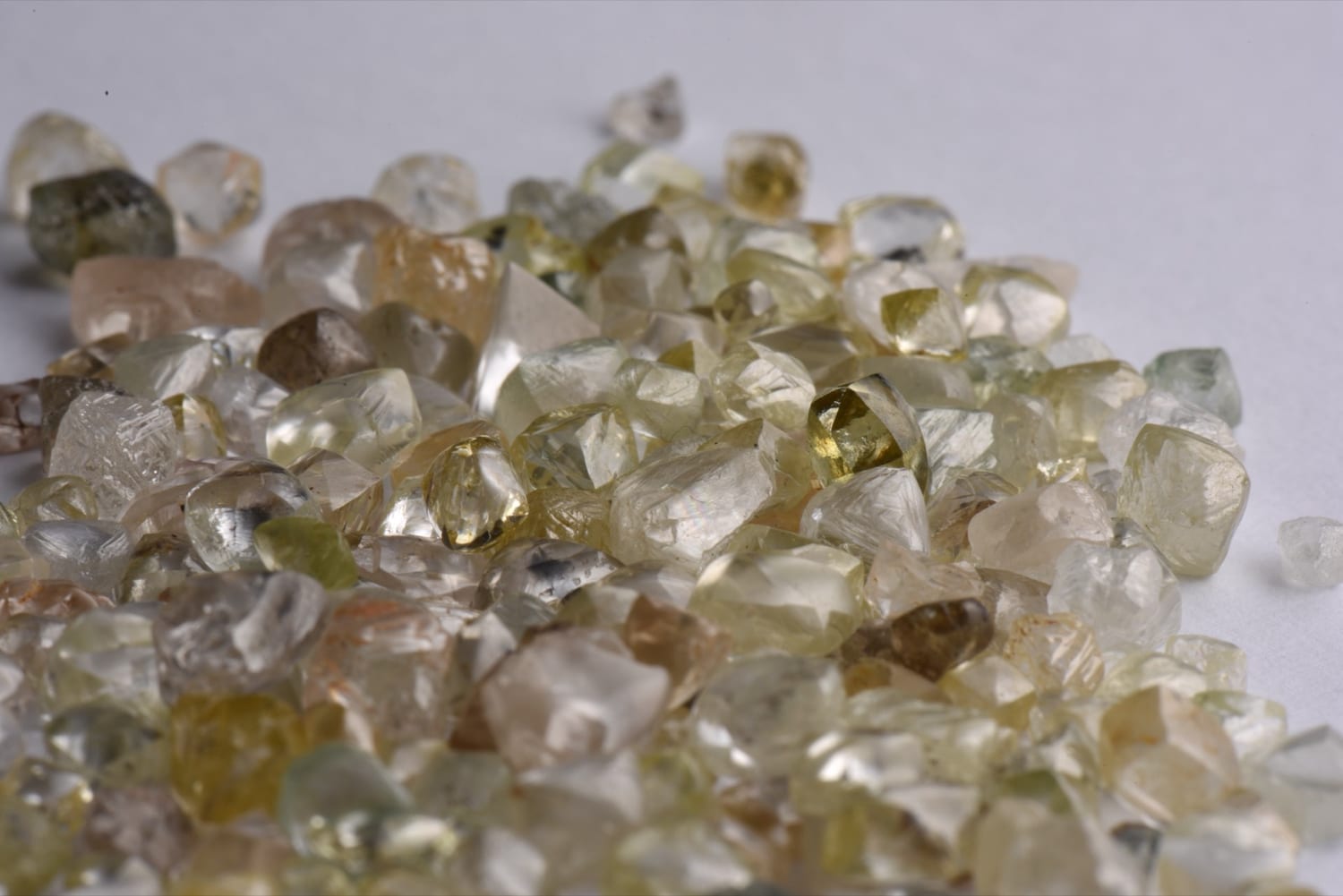
Ideally a diamond is pure carbon and nothing else. In practice, as the crystal grows over an unimaginable span of time, stray atoms of other elements are caught in the lattice — and it is their presence, more than any facet, that decides what the stone can become. Diamonds divide into two atomic types by whether they carry nitrogen, and those types govern colour, rarity and, in the end, value.
| Type | Nitrogen | Atomic structure | Typical colours | Occurrence |
|---|---|---|---|---|
| Ia | With N | Clustered nitrogen atoms | Colourless, yellow | ~98% |
| Ib | With N | Scattered nitrogen atoms | Yellow, orange, brown | ~0.1% |
| IIa | Without N | Lattice distortion (insulator) | Colourless; fancy pink, brown | ~1.8% |
| IIb | Without N | Boron atoms (semi-conductive) | Blue-grey | ~0.1% |
The lesson hides in the last column. The overwhelming majority of diamonds — some 98% — are Type Ia. The Type IIa stones, free of nitrogen and often exceptionally limpid, are rare enough to set auction records; the great historic whites belong to this family, as do many of the finest fancy pinks. Nearly all fancy-coloured diamonds come from the type II families — the boron-bearing Type IIb giving the world its rare blues. For an Antwerp house this is no academic footnote: type can be the difference between a stone worth a few thousand euro and one worth several million.
The anatomy of a polished diamond
A diamond is a single crystal of ordered carbon — but a polished diamond is a precise piece of geometry with a vocabulary all its own. Before the four Cs make sense, the parts have to have names, because a grade, a certificate and a set of proportions are all written in them.
- Diameter — the width of the stone, measured edge to edge across the girdle.
- Table — the largest facet, the flat plane on the very top of the crown.
- Crown — the upper portion, from the table edge down to the girdle.
- Girdle — the narrow band at the widest point, where crown meets pavilion; it may be bruted (frosted), polished, or faceted.
- Pavilion — the lower portion, sloping from the girdle down toward the point.
- Culet — the small facet, or point, at the very bottom. Ideally small to none, so no light leaks through the floor of the stone.
- Depth — the total height from table to culet, the figure behind a stone looking “deep” or “shallow”.
A table cut too large floods the stone with white brilliance at the cost of fire; a pavilion cut too deep or too shallow spills light out of the bottom instead of returning it to the eye. Read together — table, crown angle, girdle, pavilion depth, culet — the anatomy is the cut, told as numbers.
Cut — the only C made by hand
For most graders, cut is the most important of the four. It defines not only a diamond’s shape but, far more, its brilliance and its fire — and it is the most human of the four, the only C not set by geology but by a cutter’s judgement. Cut well, a diamond appears larger, brighter and more alive than its weight suggests. Cut poorly — too deep, too shallow, or carelessly finished — and the light leaks away through the pavilion no matter how fine the colour or clarity above it.
The ideal cut
An ideal cut is proportioned so that the maximum of the light entering the crown is returned through the crown to the eye, rather than escaping through the bottom. The proportions that draw such brilliance from the round brilliant were not arrived at quickly. They emerged from decades of patient study, in which the way a diamond bends and scatters light was measured against the demands of its own exceptional hardness, until the geometry that returns the most light to the eye was finally fixed. Any deviation from that model — imprecise proportions, careless symmetry, a dull polish — costs the stone appearance and brilliance, and the grade records the cost.
Brilliance, dispersion, scintillation
A well-cut diamond shows three distinct properties, and it helps to hold them apart:
- Brilliance — the white light returned to the eye from the surface and the interior.
- Dispersion — the splitting of white light into spectral colours, the “fire” of a diamond.
- Scintillation — the flashes of light and dark that play across the stone as it, or you, moves.
Proportion, symmetry and polish
Cut is really three things working together. Proportion is the geometry — the angles and percentages that decide where the light goes. Symmetry describes how precisely the facets meet and align. Polish describes the smoothness of each facet’s surface, free of the fine lines and marks the cutting wheel can leave. The figures below show how a round brilliant’s proportions map to the grade bands, from excellent to below average.
| Measure | 1 — Excellent | 2 — Very good | 3 — Average | 4 — Below avg |
|---|---|---|---|---|
| Table size | 53–60% | 61–64% | 65–70% | >70% |
| Crown angle | 34–35° | 32–34° | 30–32° | <30° |
| Girdle | medium – slightly thin/thick | thin – thick | very thin – very thick | extremely thin/thick |
| Pavilion depth | 43% | 42–44% | 41–46% | <41% / >46% |
| Culet | none – medium | fairly large | large | very large |
| Finish | very good – excellent | good | average | below average |
For stones under 0.50 ct the excellent table band widens slightly, to 53–62%. Cut grades run excellent · very good · good · medium · poor; certain laboratories add their own top “excellent” band, though it remains a debated addition, not adopted by every lab or for every cut.
Hearts & Arrows
Seen from above through a special viewer, a diamond of true optical symmetry shows an exact pattern: eight grey arrows face up, and eight grey hearts face down. Hearts and Arrows is the ultimate expression of precise cutting — a near-perfect symmetry that only the most exactingly cut stones display, and the surest visual sign that proportion, symmetry and polish have all been honoured at once.
Colour — the flight from yellow
Typically diamonds are transparent, with barely perceptible hints of colour. With the exception of fancy-coloured stones — where colour is the prize — the rarest diamonds are the most colourless. Grades run from D to Z, with D the rarest of all.
In its purest state a diamond is carbon and nothing else, and such purity is rare. As the crystal grows, stray atoms become caught among the carbon, and it is their presence that gives a stone its tint. Nitrogen is the usual culprit, lending the faint yellow warmth the scale measures. The less of it a diamond carries, the more colourless — and the more prized — the stone.
Reading the scale
| Grade | GIA category | Old-world name |
|---|---|---|
| D – F | Colourless | Exceptional white · Rare white |
| G – J | Near colourless | Fine white · Top crystal |
| K – M | Faint | Top cape · Crystal |
| N – R | Very light | Very light yellow |
| S – Z | Light | Light yellow |
Colourless (D–F). The top of the scale. These stones show virtually no colour and are valued accordingly; the difference between a D and an F is visible only to a trained grader against a comparison set.
Near colourless (G–J). Excellent value, and where a knowing buyer often lands. A faint warmth exists but is hard to detect once the stone is set, especially in a white-gold or platinum mount.
Faint to light (K–Z). A warmth becomes perceptible, most often from nitrogen scattered through the lattice. Many buyers find a warm K beautiful in yellow gold, where the metal flatters rather than fights the tint.
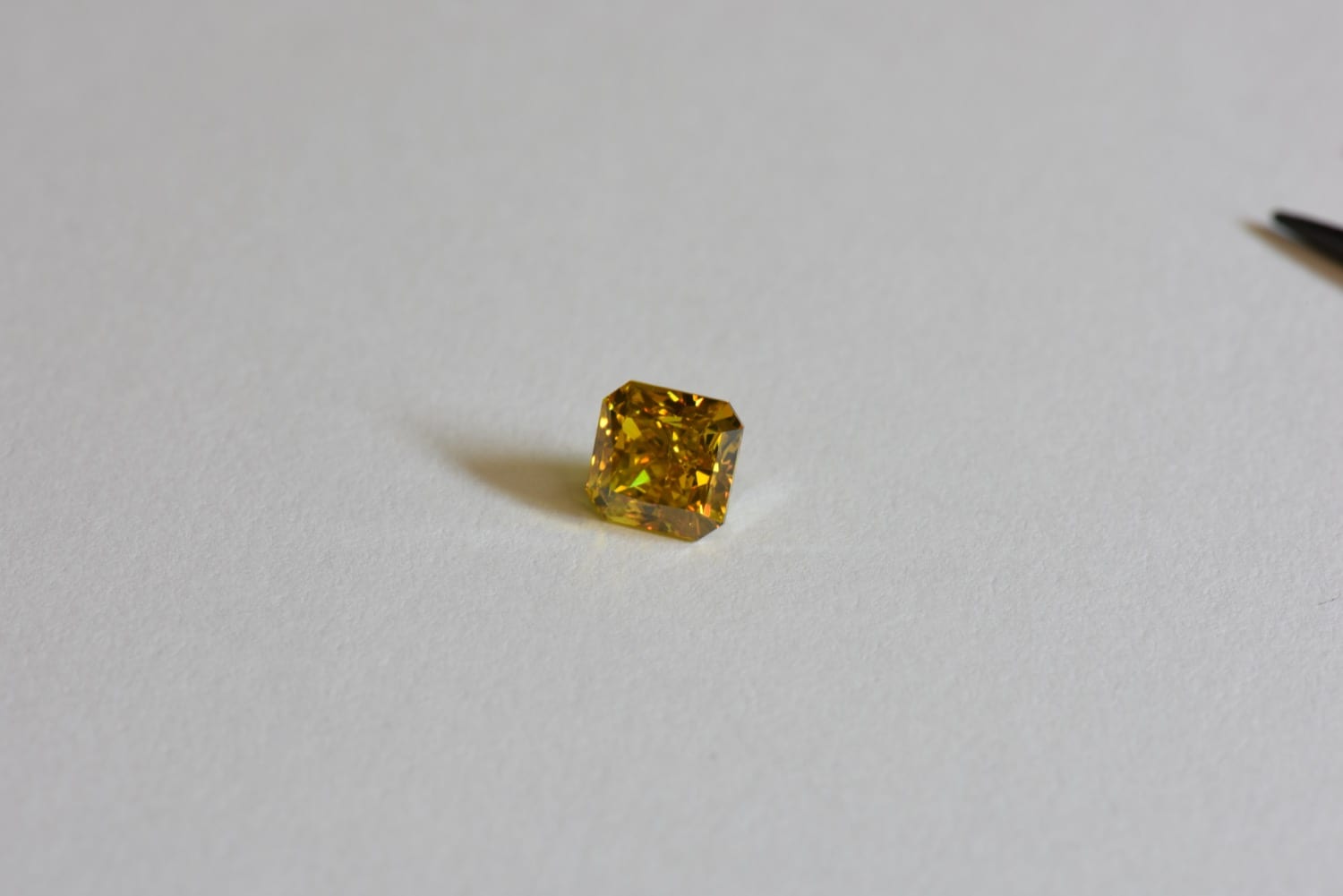
Beyond the bottom of the scale, the rules invert. When colour deepens past Z into a true, saturated hue, a diamond is no longer “tinted” but fancy-coloured — and among the rarest, most valuable stones on earth, graded on a different logic entirely.
Fluorescence
Fluorescence is a naturally occurring phenomenon: certain minerals and gems glow when struck by ultraviolet light. Around a third of all diamonds fluoresce to some degree, most often a soft blue visible under UV and invisible in ordinary daylight. Graders record it by strength, from None through Faint, Medium, Strong and Very Strong — one of the observations made during colour grading, because it too betrays a stone’s type and whether its colour has been treated.
The effect on value cuts both ways, which is why it deserves its own line on the report:
- Among the finest colours (D–H), a strong blue reaction can occasionally soften a stone under daylight rich in ultraviolet, leaving it faintly hazy or oily to the eye. Buyers tend to pay less for it.
- In faintly tinted stones (I–M), the same blue glow works the other way. By cooling the warmth of a yellowish body colour, it can make such a diamond read whiter than its grade suggests under natural light — a quiet, if modest, kindness to the stone, and sometimes a bargain.
Clarity — the crystal’s own record
Most diamonds seem completely transparent to the naked eye. In fact they often contain inclusions — crystals, feathers, clouds — so slight that they show only under a loupe. Think of them less as flaws than as a signature. A diamond crystallises over an immense span of time, under heat and pressure that shift as it grows; wherever those conditions waver, the carbon traps a tiny witness to the moment. Clarity is simply the reading of those witnesses at ten-times magnification.
The clarity scale
| Grade | Name | What you see |
|---|---|---|
| FL · IF | Flawless · Internally Flawless | No internal features; at most minor surface marks |
| VVS1 · VVS2 | Very, very slightly included | Minute inclusions, very difficult to see even with a loupe |
| VS1 · VS2 | Very slightly included | Minor inclusions, difficult to somewhat easy to see |
| SI1 · SI2 | Slightly included | Noticeable under the loupe; SI2 sometimes visible to the eye |
| I1 · I2 · I3 | Included | Visible to the naked eye, increasingly affecting brilliance |
A stone that shows nothing at all — no inclusion, no surface mark — sits at the summit of the scale, and such stones are uncommon. GIA records them as Flawless: no internal or external features under the loupe, bar a few permitted naturals. The IDC reaches the same point by another name and calls it Loupe Clean — the same stone, a different house style on the paper.
A grader’s method
Inclusions are described by where they sit and what they are — pinpoints and clouds, feathers and fractures, naturals left on the girdle, growth and twinning lines. The difference between, say, VVS1 and VVS2 comes down to the size, position, brightness and number of those features, and it is recorded not only as a letter but as a plotted map on the certificate.
Carat — weight, not size
Carat is the measure of weight for diamonds — abbreviated ct, where 1 ct = 0.20 grams. Very small brilliants are measured in points (1 pt = 0.01 ct), and weight is sometimes given in grains (1 ct = 4 grains). The word has nothing to do with size directly: two stones of equal weight can look quite different depending on how they are cut, one spread wide and shallow, the other carrying its weight hidden in a deep pavilion.
Caraters and parcels
In the trade a “carater” is a band of weight rather than an exact figure — a shorthand a house uses across a whole parcel:
| Carater | Weight range |
|---|---|
| 1 ct | 0.95 – 1.05 ct |
| ¾ ct | 0.72 – 0.76 ct |
| ½ ct | 0.47 – 0.56 ct |
| ¼ ct | 0.23 – 0.26 ct |
When buying loose small goods, one buys mêlé parcels — French for mixed — typically diamonds from 7 to 15 points. A parcel of only the larger 12-to-15-point goods is called coarse mêlé.
Size and the rarity premium
Larger diamonds are far rarer in nature than small ones, and price per carat rises steeply with weight. A single two-carat stone is worth considerably more than two one-carat stones of the same quality, precisely because the larger rough it came from is so much scarcer. Weight, more than any other C, is the visible lever on price — which is also why it is the one most worth handling with care.
The authentication test
Comparing a stone’s weight with its measurements and its density helps prove it genuine — a check a grader makes when a stone arrives without paper. The Scharffenberg formula is a fine tool for it. For a round brilliant:
ct weight = height (mm) × Ø² (mm) × 0.0061
If the calculated weight matches the weighed weight, the stone is not an imitation glued up to look heavier than it is. Density confirms it: measured on a hydrostatic balance, the specific gravity of diamond is 3.52 — a figure no common imitation shares.
The grader’s bench
Good grading is repeatable grading, and repeatability comes from the bench. The equipment of a professional grader, gathered over years, is what lets the same stone read the same way twice — and what separates a documented grade from an educated guess.
- 10× magnifying loupe — the standard for clarity, by international convention
- Carat balance — for weight, to a hundredth of a carat
- Hydrostatic balance — for specific gravity (diamond reads 3.52)
- Leveridge gauge — for measurements, often electronic
- Diamond-grading daylight lamp — producing diffuse, neutral light
- UV lamp — for fluorescence, ideally with a fluorescence comparison set
- Comparison set — clean master stones spaced at intervals, for colour
- Hearts & Arrows viewer — for optical symmetry
- Proportionscope — for reading proportions
- Spectroscope — for absorption spectra and type
- Microscope — for advanced research and detection
- Low-magnification lenses — a binocular forehead loupe, for general work
- Tongs, a cleaning cloth, and white folded paper to rest the stones on
Certification — the word you can check
A grader’s reading, however expert, is a private opinion until an independent laboratory writes it down. A certificate — properly, a grading report — is what turns that opinion into a documented, checkable fact: an impartial record of a stone’s characteristics, and with it a reliable measure of its worth. For a buyer not yet fluent in diamonds, the report is the firmer ground to stand on. Choose a stone that comes already certified, and where you wish to be doubly sure, take the report back to the laboratory that issued it and have the grades confirmed at the source. Both GIA and HRD keep their reports on file and open to lookup, so the reference number on any certificate can be matched against the laboratory’s own record at any time. A grade you can confirm is a grade you can trust.
The institutions
The diamond trade is, at heart, a trade in trust — a stone changes hands many times between the mine and the finger, and at every step the parties rely on a shared language. A handful of institutions supply it:
- GIA — the Gemological Institute of America, founded in 1931, gave the world the 4Cs and the D-to-Z scale. Its reports are the most widely recognised in the trade, valued for consistency and independence. It grades the stone, not the sale — it does not buy, sell or appraise value — which is precisely what makes its word carry.
- HRD Antwerp — Europe’s reference laboratory, rooted in the city that has been the heart of the trade for centuries. Its certificates follow IDC conventions, and it is also a centre for education and research, especially esteemed for rough.
- AWDC — the Antwerp World Diamond Centre, official representative of the Belgian diamond sector. It does not grade; it coordinates the bourses, logistics and regulation that keep a very large share of the world’s rough and polished flowing through Antwerp.
- WFDB — the World Federation of Diamond Bourses, umbrella for the exchanges where dealers meet. It sets the conduct and arbitration rules shared across member exchanges, so that a deal sealed by the trade’s traditional words, Mazal u’Bracha, is honoured the same way in every member bourse.
- CIBJO — the World Jewellery Confederation, which harmonises standards across the trade through its Blue Books and holds consultative standing with the United Nations on consumer confidence.
- IGI — the International Gemological Institute, founded in Antwerp in 1975, one of the largest independent labs, broad in finished jewellery and, lately, laboratory-grown stones.
- Rapaport — not a laboratory but a benchmark. Its weekly price list sets reference prices by shape, weight, colour and clarity, and the trade quotes stones as a discount or premium to “Rap” — the number behind almost every diamond negotiation.
Reading a GIA or HRD report
A stone’s report is a single page, and it repays reading top to bottom rather than glancing at the grade line alone:
- Report number & date — a unique reference, often laser-inscribed in microscopic letters on the girdle. Match the inscription to the paper, and the paper to the lab’s online database.
- Shape & cutting style — round brilliant, or a fancy shape and its faceting.
- Measurements — the stone’s dimensions in millimetres. With weight and density, these are how a stone is confirmed against its own certificate.
- Carat weight — recorded to the hundredth of a carat.
- Colour grade — D to Z, or, past Z, a fancy-colour description.
- Clarity grade — FL to I3, supported by a plotted diagram.
- Cut, polish & symmetry — cut graded for round brilliants; polish and symmetry graded for all.
- Fluorescence — none to very strong, with the colour of the reaction.
- The clarity plot — a map of the inclusions drawn to scale: the diamond’s fingerprint, since no two stones of the same grade are ever plotted alike.
- Proportions diagram — table and depth percentages, crown and pavilion angles, girdle and culet.
- Comments — anything the standard fields do not capture, including the disclosure of any treatment.
One caution: GIA reports in the GIA system and HRD in the IDC system, so the wording differs even where the meaning does not — HRD’s “Loupe Clean” is GIA’s “Flawless”. Both are trustworthy; the knowing buyer simply keeps track of which report is in front of them.
Where graders are trained
To learn grading properly, you take a course, and by common agreement the two finest schools are GIA and HRD — GIA for its complete gemmological educations, HRD especially reputed for diamonds, and for rough in particular. Many of the graders working across Antwerp today trained at one or the other, which is part of why a report from either reads the same in Antwerp as it does in New York.
Spending across the four
No stone is all four things at once inside a real budget, so grading, in the end, is a guide to spending. A house’s advice, refined over many parcels, stays consistent:
- Buy the cut first. It is the only C made by hand and the one you actually see across a room. An excellent cut in a modest colour will outshine a lazy cut in a fine one — so never economise here.
- Let colour fall to near-colourless. Once a stone is set, especially in white gold or platinum, the difference between a D and a well-chosen G is invisible to all but a trained eye against a master set — and the saving is real.
- Buy clarity eye-clean, not flawless. A VS, or a well-chosen SI whose inclusions hide under the crown, can look identical to an internally flawless stone at a fraction of the price. Read the plot, not just the letter.
- Mind the carat thresholds. Prices jump at the round numbers; a 0.95 ct gives the one-carat look for noticeably less, freeing budget for the cut and colour you will see every day.
- Treat fancy colour as a different market — there, colour is the prize, and the ordinary rules invert.
Read this way, the 4Cs are not four hurdles but four levers. The grader’s discipline is what tells you where each one is worth pulling — and where, quietly, it is not. That judgement, confirmed on a certificate you can check, is the whole of what a diamond house sells.
Related reading