The Miner
How Diamonds Form & Are Mined
How a diamond crystallises in the deep earth, where it comes to rest, and how the kimberlite pipe and the alluvial river are each worked to recover it.
Strip a diamond down to its essentials and you are left with a single element: carbon, the same stuff as soot and pencil lead. What sets the gem apart is not its ingredients but its architecture. The carbon atoms sit in a lattice bound more tightly than any other arrangement found in nature, and it is that density of bonding, rather than any rare component, that gives the stone its hardness. Let the same atoms relax into a looser order and you have graphite — so soft it leaves a mark on paper. The element is identical; only the geometry has changed.
That geometry is also why no two rough diamonds are ever quite alike. Each crystal is a record of the particular pocket of the deep earth that made it, and of the violent piece of geology that carried it up — a story written into the stone long before a cutter reads it. To understand a polished diamond, it helps to follow it backwards: from the finger, to the cutting bench, to the mine, and finally to the furnace a hundred and fifty kilometres beneath our feet where the whole thing began.
Crystal habit
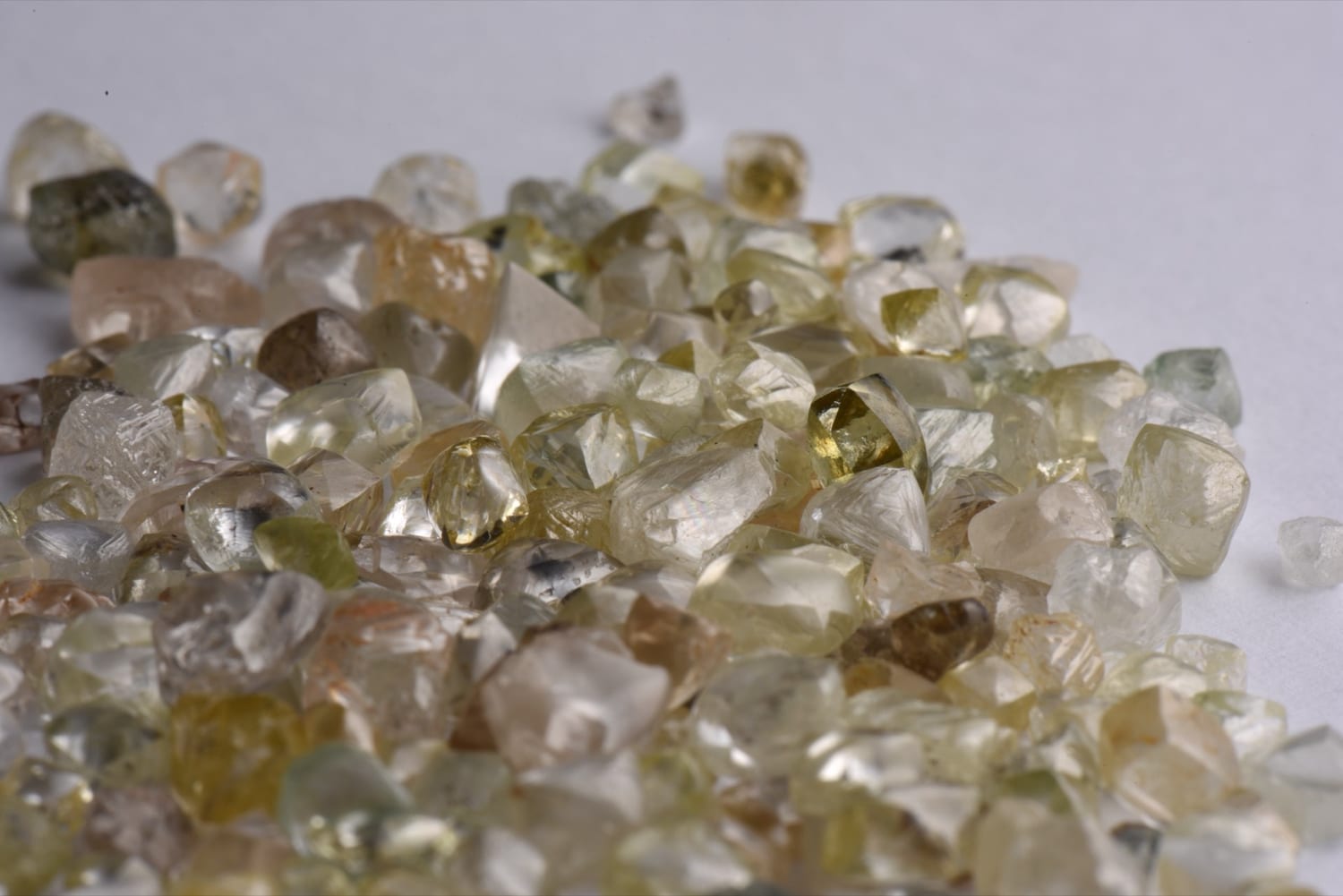
Because diamond belongs to the cubic crystal system, the discipline of its internal lattice tends to surface in the shape a rough stone takes — its habit. The form you meet most often is the octahedron, two four-sided pyramids joined base to base into eight triangular faces. Now and then a crystal will instead present twelve faces as a rhombic dodecahedron, and rarest of the three is the plain six-faced cube.
| Habit | Faces | Frequency |
|---|---|---|
| Octahedron | 8 | The common form |
| Rhombic dodecahedron | 12 | Less common |
| Cube | 6 | Rarest of the three |
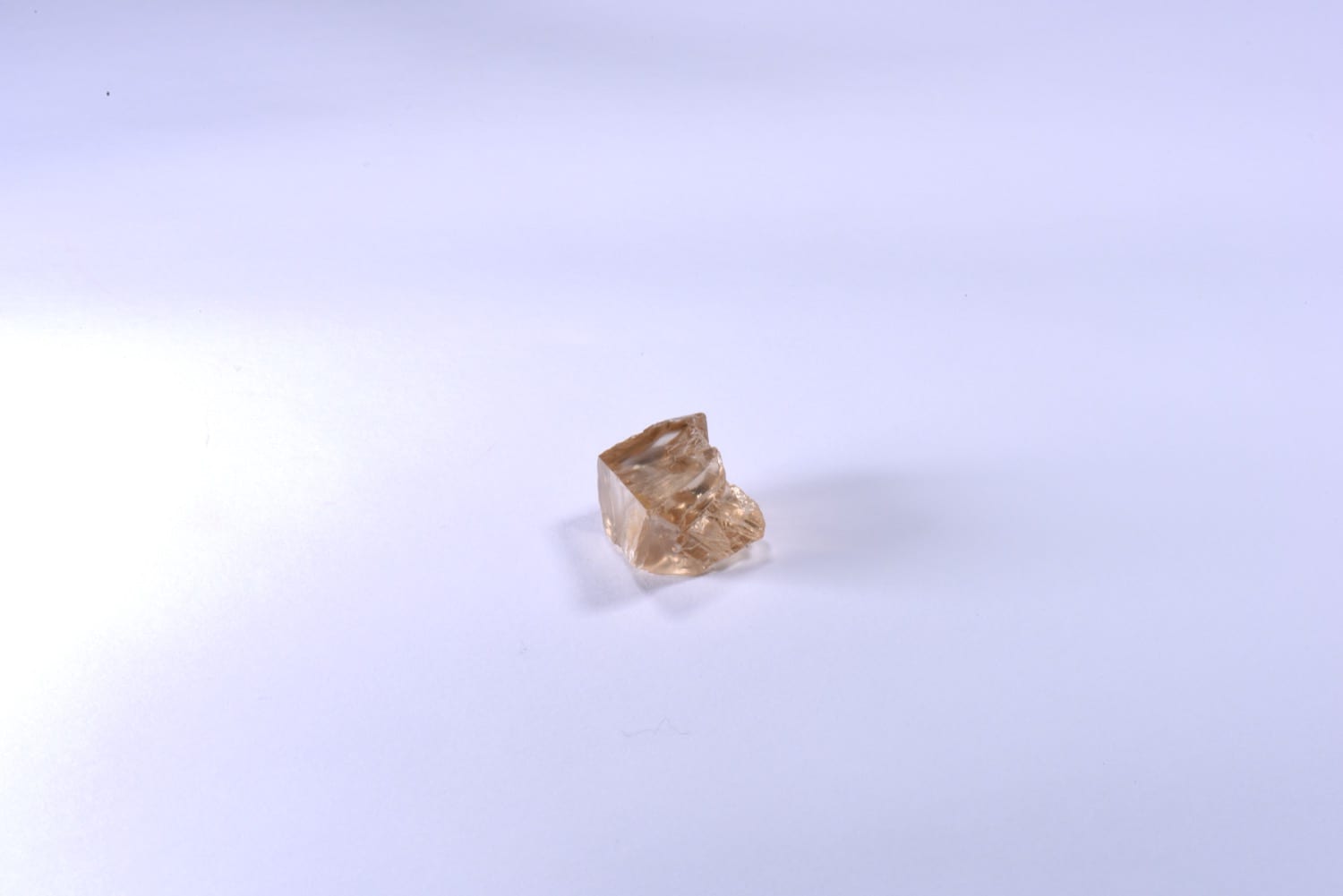
The rough tells its story before a single facet is cut. Read the surface of a good octahedron and you find the clean crystal faces, the frosted skin the earth left on it, and the trigons — tiny triangular etch-marks worked into the faces over hundreds of millions of years. To hold one is to hold a legible record of the deep earth, and the first decision in the long craft that ends in light: the cutter must find, inside that dull and irregular crystal, the brightest polished stone it is willing to give up.
The deep-earth furnace
Almost everything we understand about how a diamond is born has been reconstructed in reverse, from the laboratory conditions under which synthetic stones are grown. On the best evidence, the crystals take shape inside slowly cooling magma — a setting that demands a pressure in the region of 70,000 atmospheres and a temperature close to 1,300° centigrade. Conditions that severe are reached nowhere near the surface; you must descend to between 130 and 200 kilometres, into the mantle that feeds an active volcano, before they are met. A diamond, in other words, is not a surface phenomenon that happens to be buried. It is a creature of the depths that only ever visits daylight.
No two pockets of that magma carry exactly the same chemistry, and the differences are inscribed in the stones themselves. Should nitrogen be drawn into the carbon lattice as the crystal grows, what emerges is classed as a Type I diamond; a lattice that keeps nitrogen out yields a Type II, the rarer and often more transparent class. And whenever the temperature or the pressure lurches mid-growth, the crystal keeps a record of the upset — twin planes, growth layers, and the inclusions a grader will later decipher beneath the loupe. The flaws are not accidents added later. They are the fingerprint of the exact conditions that made the stone.
The journey to the surface
Everything about a diamond presumes the depths; bring it up too gently and it unmakes itself. Unless the rising crystal is carried to the surface fast enough that heat and pressure fall away almost at once, it simply reverts to graphite on the way. Survival therefore hinged on speed, and the only thing fast enough was catastrophe: violent volcanic eruptions that drove the stones skyward before they could decompose. What reaches the surface is less a journey than an escape — and only the most abrupt eruptions deliver an intact crystal.
The diamonds travelled, and are still recovered, inside a volcanic rock named kimberlite. The vertical shafts it solidified within — pipes, in a miner’s shorthand — were emplaced somewhere between 100 million and 1.2 billion years ago, and they are the reason a diamond mine looks the way it does: not a seam to be followed, but a roughly circular chimney to be worked downward. Each pipe is the frozen throat of an eruption the earth staged and then abandoned.
Primary and secondary deposits
Diamond-bearing kimberlite pipes are scattered unevenly across the planet — the legacy of hundreds of millions of years of plate movement, as continents split, drifted and fused again into new landmasses. A handful of nations now supply the overwhelming share of the world’s rough: Russia, Botswana, South Africa, Angola, Namibia, Australia and the Democratic Republic of the Congo together account for roughly 80% of annual production. Wherever they sit, deposits fall into two families, and the distinction governs everything about how a stone is mined.
A primary deposit is a diamond found where it arrived — in the kimberlite chimney itself, the original vehicle that raised the crystal from the depths to daylight. Mine a primary deposit and you are working the rock the diamond travelled in, undisturbed since the eruption that placed it there.
A secondary deposit is what weather makes of the first. Over millions of years, rain and frost break exposed kimberlite down; as the rock decomposes, the diamonds locked inside are released and carried off by river, sea or wind. Here the stone’s own weight does the sorting. A diamond’s specific gravity of 3.52 makes it markedly heavier than the sand and gravel travelling alongside it, so it drops out of suspension and gathers wherever a current loses its pace. Stones recovered from these beds are known as alluvial diamonds — and a diamond need not stop at a single move.
| Deposit | Where the diamond sits | Name |
|---|---|---|
| Primary | In the kimberlite pipe of its origin | Pipe diamond |
| Secondary | Moved by water, sea or wind from the pipe | Alluvial diamond |
| Tertiary, quaternary… | Re-transported again from a secondary bed | Alluvial diamond |
Each further move is a fresh sorting. A secondary bed can itself be eroded and its stones shifted on into tertiary, quaternary and later deposits, and every journey culls the weak: the flawed and fractured crystals shatter along the way, while the soundest survive. This is why alluvial stones, though fewer, are often of exceptional quality — nature has already done a first, brutal pass of the sorting a grader will later finish by hand.
Mining the pipe
Because the two deposits sit so differently in the ground, diamonds are recovered in two fundamentally different ways. Pipe mining extracts the stones from the kimberlite where they formed. Inside a pipe the rock changes with depth, and miners read those layers by colour. Near the surface lies the weathered yellow ground; below it the fresher blue ground; and deeper still the unweathered hard ground. Past a certain depth, the open pit that starts the work gives way to underground mining, following the chimney down.
| Layer | Depth | Character |
|---|---|---|
| Yellow ground | 10–30 m | Weathered, yellow kimberlite |
| Blue ground | 30–500 m | Fresher, blue kimberlite |
| Hard ground | below 500 m | Unweathered, grey kimberlite |
The scale is worth pausing on: pipe mining moves mountains of ground for a handful of carats. A rich pipe still yields only a gram or two of diamond for every several tonnes of rock crushed, which is why the economics of the whole trade rest on efficient recovery. Nothing may be lost between the rock and the sorting house.
Mining the rivers
Alluvial mining recovers everything the water, sea and wind carried away — and its principle has not changed since the earliest miners worked the gravels with picks and sieves. Only the machinery has grown. Two old methods show how cleverly the diamond’s own weight was put to work.
The first alluvial technique was the batea — the pan. Swirled in a circular motion, the dense diamond separated itself from the lighter dust and settled to the bottom. It is the simplest method there is, and small-scale miners without the means for modern equipment still use it today. The Long Tom, borrowed from the Australian gold fields and brought to South Africa’s diamond sector, both washed and roughly sorted: an inclined trough fitted with small wooden bars — riffles — nailed across it end to end. Gravel was tipped in at the top and flushed down with water; the heavier material lodged against the riffles and went straight to the sorting table.
At scale, the same idea is simply mechanised. Earth-moving equipment feeds the alluvium through coarse sieving and a rotary trommel before it reaches a large washing pan; what remains passes through concentrate sieving, a picking table and a grease table, where diamonds — which repel water but cling to grease — stick fast while the wet gravel washes away. Where alluvial stones have come to rest on dry land, often in coastal tertiary beds, the ground is worked as dry diggings; the machinery is much the same, and the stones tend to be heavy and sound, having survived several journeys to get there.
What the rough is worth
All of this stands behind the polished stone in a window, and it explains a few things a buyer feels without always being told. The finite geology is the first: because the eruptions that make diamonds have ended, no new supply is being made, and a natural stone is a closed account the earth stopped adding to long ago. The crystal habit is the second: the shape and soundness of the rough set the outer limit on what a cutter can achieve, which is why a superb polished diamond begins as a superb crystal, not merely a large one. And the sorting of the deposits is the third — the reason two stones of the same weight can be worth very different sums.
At the buying end of the trade, the rough is sold by the parcel, drawn from the mining corporations that supply the market and read grain by grain on a sorting table before a facet is ever cut. This is the work an Antwerp house does closest to the source: judging, in a dull and irregular crystal, the polished stone waiting inside it, and the origin — Kimberley-Process certified, conflict-free — before any price is agreed. Understanding where a diamond comes from is not romance. It is the first and most practical step in knowing what it is worth, and in buying it well.
Related reading